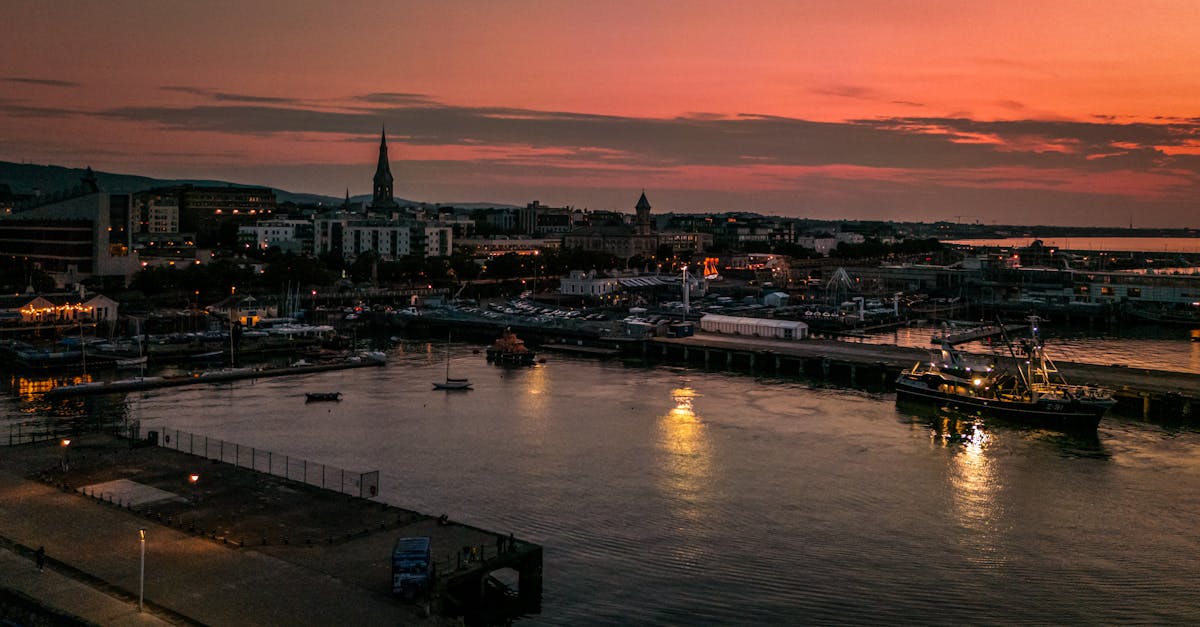
"The coldest swim on the 70.3 circuit — wetsuits are your friend here."
🏊 Swim
Irish Sea swim in Scotsman Bay — cold water guaranteed
🚴 Bike
Rolling course through Wicklow hills
🏃 Run
Flat run along the coast
Transition Details
T1/T2 are in different locations · Surface: pavement
Weather
Typical race-day conditions: 16°C with 70% humidity.
Registration
https://www.example.com/ironman-70-3-dun-laoghaire
The Story
Dun Laoghaire (pronounced 'Dun Leery') is a seaside town on the southern shore of Dublin Bay — a Victorian harbour with granite piers, sailing clubs, and the particular brand of Irish coastal charm that involves excellent pubs, unreliable weather, and water cold enough to make you question every decision that led you here.
The Irish Sea swim is the headline act: 14°C in August. Let that temperature sit with you for a moment. Fourteen degrees. That's genuinely cold — cold enough that some editions have been modified due to water temperature concerns. Wetsuits are mandatory and welcome, but even with neoprene, the first minutes in the Irish Sea are a full-body protest. Your hands go numb. Your face aches. Your breathing accelerates involuntarily as your body fights the cold-water shock response. And then, gradually, your body acclimatises. The gasping subsides. The numbness becomes background noise. And you realise you're swimming in Dublin Bay, with the Howth peninsula on one side, the Wicklow Mountains on the other, and the Victorian pier stretching out beside you like a granite guardian. The water is clear — surprisingly so — and the Irish Sea has a weight and wildness that makes every other open-water swim feel domesticated.
The bike heads south into the Dublin and Wicklow hills — rolling terrain through the green countryside that inspired a thousand Irish poems and at least one Braveheart-adjacent film location. Seven hundred metres of climbing through hedgerow-lined lanes, past the Sugar Loaf mountain's distinctive cone, and through villages where the pubs outnumber the houses. The Wicklow hills are not Alpine — they're not high enough to intimidate — but they're relentless in the way Irish terrain always is: rolling, undulating, never flat for long, and always with another rise waiting around the corner. The road surfaces are good by Irish standards, the route well-marshalled, and the views of the Wicklow hills — green and brown and impossibly textured — are the kind of landscape that makes you understand why the Irish are so attached to their countryside.
The run follows the Dun Laoghaire coastal path, with Dublin Bay on one side and the Victorian architecture on the other. The seafront promenade gives you views across to Howth, and the August light — when it cooperates — catches the bay in shades of grey and blue that photographers spend careers chasing. The Irish crowd brings what Irish crowds always bring: warmth that has nothing to do with the temperature. The craic — that untranslatable Irish concept of fun, conversation, and communal enjoyment — transforms the finish area into something between a race celebration and a session at the local.
Eighty-two nations on the start list in a town of 27,000 people tells you something about the pull of Irish triathlon. The race draws heavily from Britain and mainland Europe, but the international contingent comes for something specific: the combination of cold-water swimming, green-hill cycling, and the social atmosphere that only an Irish event can deliver. The post-race pint of Guinness in a Dun Laoghaire pub — still in your tri-suit, salt in your hair, legs protesting every step to the bar — is not an optional part of the experience. It's the recovery protocol.
Dun Laoghaire 70.3 is Irish triathlon: cold water, green hills, warm people, and the quiet certainty that the weather will test you and the craic will reward you.
"Fourteen degrees. The Irish Sea doesn't negotiate. You either acclimatise or you suffer. There is no third option."
"The craic at the finish line is better than the race itself. And the race is brilliant."
"I've raced all over Europe. Dun Laoghaire has the coldest water and the warmest people. The ratio is extreme."
"Swimming in Dublin Bay with the Wicklow Mountains behind you and the Victorian pier beside you — it's terrifyingly beautiful. Emphasis on terrifying."
What It Feels Like
Ironman 70.3 Dun Laoghaire is defined by its contrasts: the coldest swim on the circuit, the warmest community atmosphere. The Irish Sea demands respect and specific preparation. The Wicklow hills demand honest fitness. The run demands the ability to keep moving when your legs carry the memory of cold water and rolling climbs. What makes Dun Laoghaire unique is the social dimension — the craic, the community, the post-race atmosphere that turns a sporting event into an Irish celebration. Eighty-two nations come for the cold water and stay for the warmth. The race is the excuse; the experience is the reason.
🏊 The Swim
The Irish Sea at 14°C: the coldest regular swim on the 70.3 circuit. This is not Mediterranean cold or even Atlantic-mild cold — this is genuine cold-water swimming that demands specific preparation. Wetsuits are mandatory, but even in neoprene your hands, feet, and face experience the full impact. The cold-water shock response — gasping, hyperventilation, panic — is a real risk for unprepared athletes. Once acclimatised (90-120 seconds), the swim settles into Dublin Bay: surprisingly clear water, views of Howth and the Wicklow coast, and the Victorian pier providing a reassuring landmark. The bay is generally sheltered, but the Irish Sea can produce chop and current when the wind picks up. This swim is a badge of honour.
🚴 The Bike
The Dublin and Wicklow hills: 700m of climbing through green Irish countryside that rolls and undulates in the way only Irish terrain does. The hills are not individually intimidating — mostly 2-5 minute efforts at moderate gradients — but they never stop coming. The hedgerow-lined lanes wind through farmland, past village pubs, and beneath the Sugar Loaf mountain's distinctive peak. The roads are well-maintained and well-marshalled on race day. The scenery is intensely green — fifty shades of green, as the tourism clichés correctly observe — and the Wicklow hills have a soft, textured beauty that's entirely different from Alpine or Mediterranean landscapes. The rolling nature rewards steady effort: surge on every hill and you'll be wrecked by halfway.
🏃 The Run
The Dun Laoghaire coastal path: flat, scenic, and lined with Irish spectators who provide a warmth that compensates for the temperature. You run along Dublin Bay with views across to Howth, past Victorian buildings and maritime heritage that speaks to the town's history as a major harbour. The August temperature (15-20°C) is ideal for running — no heat stress, no cold discomfort. The atmosphere at the finish area is distinctively Irish: music, noise, genuine communal celebration, and the ever-present offer of a post-race pint. The two-lap format means you experience the coastal path twice, and the crowd support builds on the second lap as more athletes approach the finish.
Legendary Moments
Dun Laoghaire Gets Its 70.3
Ironman 70.3 launches in Dun Laoghaire, bringing half-distance triathlon to Dublin Bay. The Irish Sea swim immediately becomes the race's defining feature — and its most feared element.
82 Nations in Dublin Bay
The race draws 82 nationalities — an extraordinary number for a relatively new event in a small Irish coastal town. The international appeal confirms that cold water and Irish atmosphere are a winning combination.
The 12°C Swim
An unusually cold Irish Sea pushes water temperatures to 12°C. The swim distance is reduced for safety. Athletes who start are given extra time. Those who finish the full course in those conditions earn a story they'll tell for decades.
The Perfect Irish Day
For once, Ireland delivers: blue skies, calm seas, 18°C air temperature. Athletes post fast times and express mild disappointment that they can't complain about the weather. The Irish crowd celebrates anyway — good weather is just another reason for craic.
💡 Insider Tips
- → Cold-water acclimatisation is the single most important preparation. Swim in 12-16°C water at least 6-8 times in the month before the race. Build from 5 minutes to 20+ minutes. The shock response diminishes with exposure.
- → Wear a neoprene swim cap under your race cap, and consider neoprene gloves and booties if regulations permit. Extremity protection makes a measurable difference in cold water.
- → The Wicklow hills are relentless but not steep. Train for rolling terrain — repeated 2-5 minute efforts with incomplete recovery. High-cadence spinning recovers you faster than grinding up each rise.
- → Dublin is 30 minutes by DART train. Stay in Dun Laoghaire for race logistics, but budget a day in Dublin for the cultural experience. The city's pubs, restaurants, and atmosphere are part of the trip.
- → The post-race Guinness is not a joke — it's a tradition. But hydrate with water first. Cold-water swimming dehydrates you more than you realise, and the Irish Sea extracts a fluid penalty that needs repaying.
- → Irish weather is unpredictable. Pack for every condition: sun cream and arm warmers, sunglasses and a rain jacket. Expect the unexpected and you'll never be caught out.
Fun Facts
- ▸ The coldest swim on the 70.3 circuit — wetsuits are your friend here.
Prepare for This Race
More Races in Ireland
FAQ
What distance is the Ironman 70.3 Dun Laoghaire? +
The Ironman 70.3 Dun Laoghaire is a Half Ironman / 70.3 distance triathlon: 1900m swim, 90km bike, and 21.1km run (113km total) in Dun Laoghaire, Ireland.
When is the Ironman 70.3 Dun Laoghaire? +
The next edition is on August 8, 2026. The race is typically held in August.
Water temperature and wetsuit rules? +
Bay water at 14°C average. Wetsuits are allowed.
How hilly is the bike course? +
700m of climbing over 90km. Profile: rolling. Drafting not allowed.
What's the weather like on race day? +
11–21°C, 70% humidity, 27% rain chance, 13 km/h winds.
Average finish time? +
Approximately 5h 48m. Varies with conditions and athlete experience.
Are you the race organizer?
Claim This RaceFree · Get featured on our homepage · Edit your race details