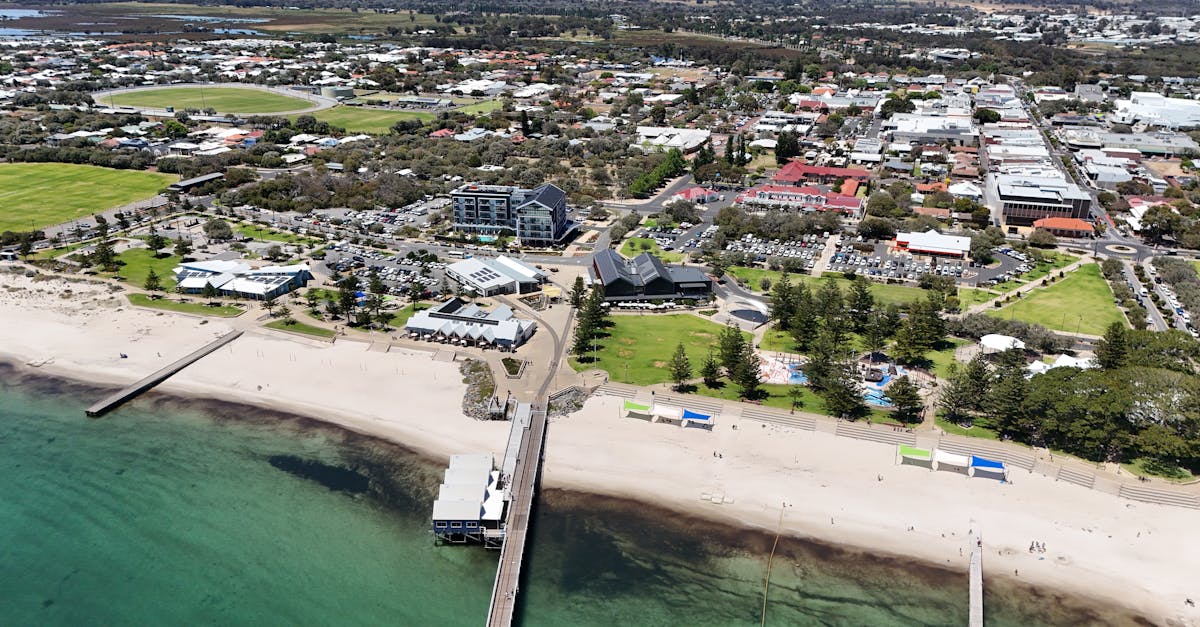
"Fast and flat — Busselton's Ironman Western Australia is built for personal bests."
🏊 Swim
Ocean swim in Busselton.
🚴 Bike
Flat bike course in Busselton.
🏃 Run
Run through Busselton.
Transition Details
T1/T2 are in different locations · Surface: pavement
Weather
Typical: 22°C, 50% humidity.
Registration
https://example.com/ironman-western-australia
The Story
Busselton sits at the end of Australia — or feels like it. Three hours south of Perth, past the suburban sprawl and through the jarrah forests, the highway delivers you to a coastal town so quiet and so far from anything that the loudest sound at dawn is the Indian Ocean moving against sand. The Busselton Jetty stretches 1,841 metres into Geographe Bay, a wooden walkway to nowhere that is the longest timber-piled jetty in the southern hemisphere. On race morning, it stands silhouetted against the Western Australian sunrise like a bridge between the land and something deeper.
Ironman Western Australia is one of the most remote major triathlons on earth. The athletes who come here have made a deliberate choice — this is not a convenient race. Perth is the most isolated city of its size in the world, and Busselton is three hours beyond that. But the remoteness is the point. What you get in exchange for the journey is a course that strips away everything unnecessary and gives you the essentials: warm ocean water, flat roads through wine country, a coastal run under Australian skies, and a community of 25,000 people who block out their December calendar for the race that has defined their town since 2003.
The swim begins on the beach beside the jetty. The Indian Ocean in Geographe Bay is sheltered — a wide, shallow bay protected from the Southern Ocean's fury by Cape Naturaliste to the west. The water sits around 20°C in December, the tail end of Australian spring, and the clarity varies with the swell: on a calm day, the sandy bottom is visible for metres; on a choppier morning, the water turns a milky jade. The swim course runs parallel to the beach with the jetty as the landmark, and the sensation of swimming in the Indian Ocean — warmer, saltier, more buoyant than the Atlantic or Pacific — is distinctive. There's a gentle current that moves along the bay, manageable for experienced open-water swimmers and barely noticeable for strong ones.
The bike course heads south through the Margaret River wine region — Australia's answer to Napa Valley, though the locals would bristle at the comparison. The 180 kilometres are flat. Properly flat. The 500 metres of total elevation gain comes in gentle undulations through dairy farms and vineyards, the kind of terrain that encourages you to settle into your aerobars and hold a pace that will be your best friend or your worst enemy on the run. The roads are wide, well-surfaced, and largely empty — this is rural Western Australia, where the distance between towns can be measured in fractions of an hour and the traffic in vehicles per hour rather than per minute. The Busselton doctor — the local name for the afternoon sea breeze — can pick up around noon, adding a headwind component on the return leg that catches athletes who left their power on the outbound sections.
The run follows the coastal strip — two laps along the foreshore, past the jetty, through the town centre, and out toward the residential streets where Busselton's families set up lawn chairs and eskies. The 47 metres of elevation gain makes this one of the flattest Ironman run courses in the world. The challenge is the afternoon heat — December in Western Australia means the mercury can push toward 30°C, and the exposed coastal route offers limited shade. The compensation is the view: the Indian Ocean on one side, the jarrah forests on the other, and ahead of you, the infinite wooden line of the jetty pointing toward the horizon like an invitation to keep going.
With 2,290 finishers from 37 countries and a 33% female field, Ironman Western Australia punches well above its geographic weight. The 12:12 average finish time reflects the heat more than the terrain, and the 7% DNF rate says more about the conditions than the course. This is Australia's Ironman at its most authentic: remote, beautiful, hot, and hosted by a town that has had twenty years to perfect the art of making you feel welcome at the edge of the world.
"Busselton is the most honest Ironman I've ever done. Flat course, warm water, no excuses. Just you and the heat and the Indian Ocean."
"You drive three hours past Perth into what feels like nowhere, and then you find a town that's been waiting all year for you to show up. That's Busso."
"The jetty is the soul of this race. You swim past it, you run past it four times, and by the end, it feels like the most beautiful thing you've ever seen."
What It Feels Like
Ironman Western Australia is a flat-course race in a hot climate at the edge of the world. The swim is warm and welcoming. The bike is fast but wind-dependent. The run is a heat battle on a beautiful coastline. The 12:12 average finish time would be faster without the December sun, and the 7% DNF rate reflects the athletes who underestimated the conditions, not the distance. Come prepared for heat and wind, and Busselton will give you one of the most memorable Ironman experiences available — the kind where remoteness becomes intimacy and a wooden jetty becomes the most significant landmark in your racing life.
🏊 The Swim
Geographe Bay is a sheltered crescent of Indian Ocean water — warmer, saltier, and more buoyant than you expect. At 20°C in December, it's comfortable without a wetsuit and pleasant with one (if legal). The sandy bottom is visible in the shallows, and the swim course runs parallel to the beach with the jetty as your constant reference point. There's a gentle longshore current that will nudge you if you don't correct, but the bay's shelter means genuine chop is rare. The water feels different from Atlantic or Mediterranean swims — softer, thicker, more forgiving.
🚴 The Bike
Flat as a cricket pitch. The 500 metres of elevation across 180 kilometres comes in rolls so gentle you barely shift gears. The Margaret River wine region slides past in a green blur of vineyards and dairy farms, the roads wide and empty in the way only rural Australia manages. The danger is the Busselton doctor — the sea breeze that typically arrives mid-morning and strengthens through the afternoon, adding a significant headwind to the return leg. Athletes who bank speed outbound on a tailwind pay compound interest coming home. Ride to power, not speed, and respect the doctor.
🏃 The Run
Two laps along the Busselton foreshore — 47 metres of elevation gain, sea views, and the relentless December sun. This is a heat-management run, not a terrain challenge. The coastal route offers minimal shade, and by early afternoon, the temperature can push toward 30°C. The jetty passes four times, each time a little more beautiful as fatigue strips away your ability to take anything for granted. The town's support is concentrated along the foreshore promenade, where lawn chairs, cold hoses, and Australian directness keep you moving when the heat says stop.
Legendary Moments
Australia's Western Outpost
The inaugural Ironman Western Australia in Busselton establishes a full-distance race at the geographic edge of the sport's map. The remoteness becomes its defining feature — athletes who make the journey find a course and community unlike anything else on the circuit.
The Doctor's Revenge
The legendary Busselton doctor — the afternoon sea breeze — arrives earlier and stronger than forecast, turning the bike course's return leg into a sustained headwind battle. Athletes who went out fast on the tailwind suffer spectacularly on the way back, rewriting pacing strategies for years to come.
Kona Qualifier's Paradise
Ironman Western Australia becomes one of the highest Kona-qualifying-slot courses per capita in the Asia-Pacific region. The flat, fast course attracts athletes hunting personal bests and world championship berths, driving the average finish time below 12 hours for strong cohorts.
Twenty Years of Busso
The race celebrates two decades in Busselton with athletes from 37 countries and the highest female participation rate in its history at 33%. The town commemorates the anniversary with a community festival that treats the Ironman as Busselton's unofficial public holiday.
💡 Insider Tips
- → Heat acclimatisation is the single most important preparation for this race. Spend at least two weeks training in heat before race day — sauna protocols, midday runs, overdressing on the bike. The December Western Australian sun is not optional adversity; it's the defining race condition.
- → Respect the Busselton doctor. Study wind forecasts obsessively in race week. The afternoon sea breeze typically arrives between 10am and noon and builds through the afternoon. If you're still on the bike at noon, you'll face a headwind that wasn't there when you started. Ride conservative splits — target negative or even bike power, not speed.
- → The Indian Ocean swim is saltier than most lake or river Ironman swims. If you've trained exclusively in freshwater, do at least two ocean sessions before the race. The increased buoyancy changes your body position and the salt stings any skin abrasion. Petroleum jelly on your neck, armpits, and wetsuit edges.
- → The run course has limited shade. Wear a white or light-coloured cap, use ice at every aid station (in your cap, in your tri suit, down the back of your neck), and accept that your pace will be slower in the heat. A 5:00 marathon split in 30°C heat is physiologically equivalent to a much faster cool-weather effort.
- → Busselton is a small town — accommodation books out fast, especially for the December race. Book a holiday rental within walking distance of the jetty precinct as soon as you register. Driving in from Margaret River or Dunsborough on race morning adds unnecessary stress.
- → Fly into Perth and rent a car. The three-hour drive south is easy and scenic, and you'll need transport during race week. Stop at a Margaret River winery on the way — it's tradition, and the cab sav is exceptional.
Prepare for This Race
More Races in Australia
FAQ
What distance is the Ironman Western Australia? +
The Ironman Western Australia is a Ironman (Full Distance) distance triathlon: 3800m swim, 180km bike, and 42.2km run (226km total) in Busselton, Australia.
When is the Ironman Western Australia? +
The next edition is on December 5, 2026. The race is typically held in December.
Water temperature and wetsuit rules? +
Ocean water at 20°C average. Wetsuit rules are conditional.
How hilly is the bike course? +
500m of climbing over 180km. Profile: flat. Drafting not allowed.
What's the weather like on race day? +
17–26°C, 50% humidity, 34% rain chance, 25 km/h winds.
Average finish time? +
Approximately 12h 12m. Varies with conditions and athlete experience.
Are you the race organizer?
Claim This RaceFree · Get featured on our homepage · Edit your race details